E-Invoicing for Importers and Exporters in Nigeria (2026 Guide)
Learn how e-invoicing works for importers and exporters in Nigeria.
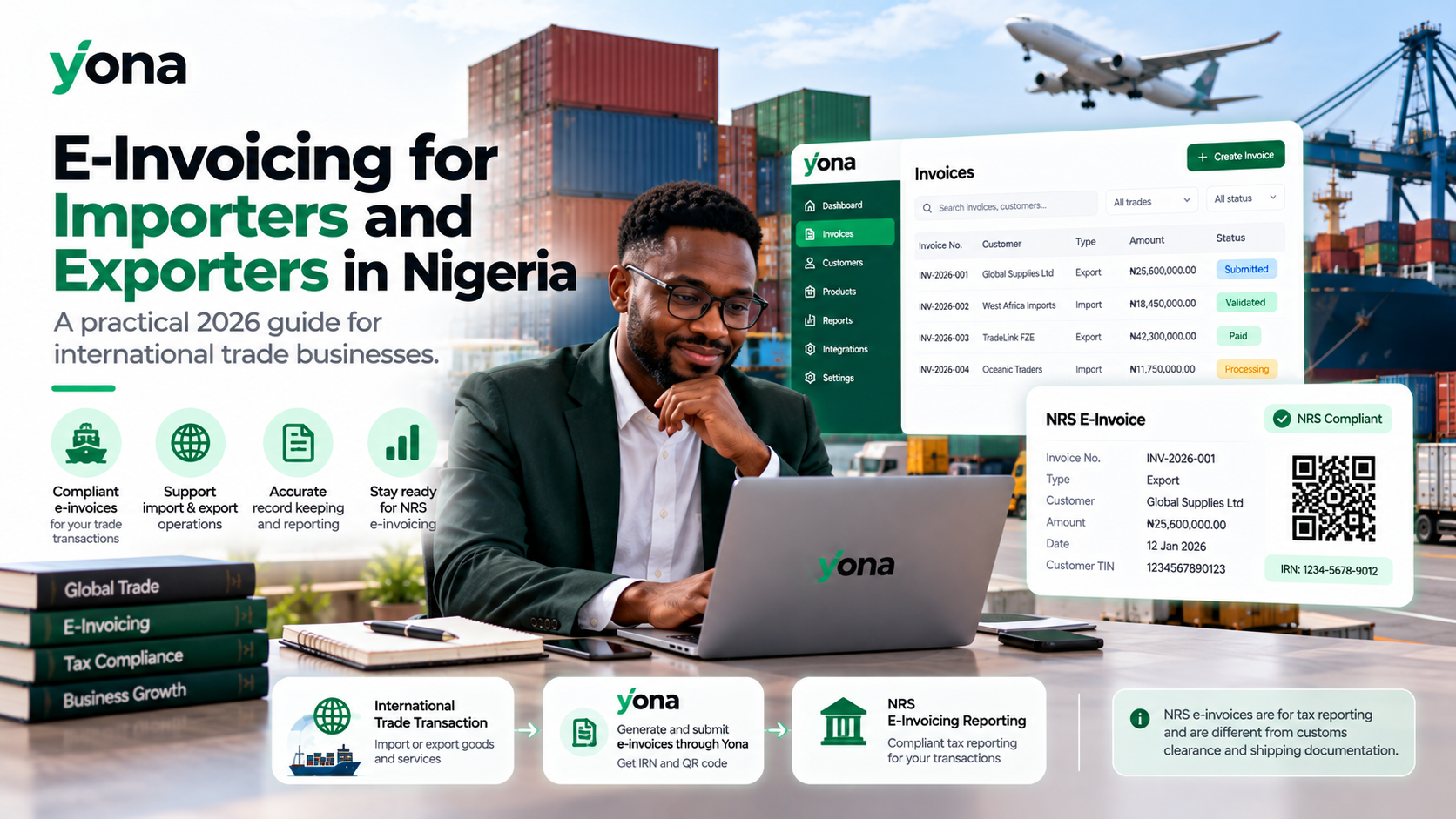
International trade involves numerous financial documents, from commercial invoices and shipping records to customs declarations and tax invoices.
For Nigerian businesses importing or exporting goods, keeping these documents accurate and organized is essential.
With the introduction of the Nigeria Revenue Service (NRS) e-invoicing system, eligible businesses must also understand how electronic tax invoicing fits into their international trade operations.
Here's what importers and exporters need to know.
What Is E-Invoicing for Importers and Exporters?
E-invoicing is the electronic creation, validation, exchange, and reporting of invoices using structured digital information.
In Nigeria, the NRS Merchant Buyer Solution (MBS) supports electronic invoicing and tax reporting.
For importers and exporters, e-invoicing can help standardize sales invoices, improve transaction records, and automate reporting where required.
However, an NRS electronic tax invoice is not the same as a customs commercial invoice or shipping document. Different requirements may apply to each.
Do Importers and Exporters Need NRS E-Invoicing?
Businesses involved in international trade may fall within Nigeria's e-invoicing requirements depending on their registration, turnover, transaction types, and applicable implementation dates.
For example:
- Importers: Nigerian businesses selling imported goods domestically may need to issue NRS-compliant invoices for applicable sales.
- Exporters: Nigerian businesses selling goods or services to foreign customers should determine how export transactions must be documented and reported.
- Trading companies: Businesses handling both local and international transactions may need workflows that distinguish different transaction categories.
Importers and exporters should also check any separate requirements imposed by customs authorities, the Central Bank of Nigeria, and other relevant agencies.
How to Manage Import and Export E-Invoicing in 5 Steps
Step 1: Verify Your Business Information
Ensure your business registration details and Tax Identification Number or Tax ID are accurate.
Confirm the information required to identify customers and suppliers, including overseas trading partners.
Step 2: Identify Your Invoice Requirements
Determine which transactions require NRS electronic invoices.
Review applicable VAT treatment, currencies, product classifications, and reporting obligations.
For international trade, maintain the separate commercial, customs, and shipping documents required for the transaction.
Step 3: Connect to an E-Invoicing Platform
Choose a solution that supports Nigeria's NRS e-invoicing requirements.
With Yona, businesses can create and submit electronic invoices through Elyonar LTD, a NITDA-licensed Access Point Provider.
Step 4: Generate and Submit Invoices
Create invoices containing the required supplier, buyer, transaction, and tax information.
Yona validates supported invoice data and processes submissions through the NRS e-invoicing network.
Successfully registered invoices receive the applicable Invoice Reference Number (IRN) and QR code.
Step 5: Automate and Maintain Records
Businesses processing large transaction volumes can use APIs to connect existing accounting, ERP, or billing systems.
Maintain records linking each invoice to the appropriate transaction, shipment, and accounting entries.
Benefits of E-Invoicing for Importers and Exporters
Electronic invoicing can provide several advantages:
- Improved accuracy: Reduce manual invoice entry and inconsistent records.
- Faster processing: Automate electronic invoice preparation and submission.
- Better visibility: Track invoices across customers and transactions.
- Easier reconciliation: Connect invoice records to accounting systems.
- Compliance support: Maintain structured records for applicable NRS reporting.
- Scalability: Handle growing trade volumes more efficiently.
Why Choose Yona for E-Invoicing?
Yona, powered by Elyonar LTD, provides electronic invoicing tools for Nigerian businesses.
With Yona, importers and exporters can:
- Generate NRS-compliant invoices for applicable transactions.
- Automate invoice validation and reporting.
- Manage issued and received invoices.
- Track electronic invoice processing.
- Integrate existing accounting and ERP systems through APIs.
- Test invoicing workflows using a sandbox environment.
For businesses with more complex systems, Elyonar LTD also provides enterprise integration services.
Frequently Asked Questions
Is NRS e-invoicing mandatory for importers and exporters?
It depends on the business's applicable compliance obligations and rollout phase. International trade activities do not automatically determine whether every transaction requires NRS e-invoicing.
Is an NRS e-invoice the same as an import or export commercial invoice?
No. An NRS e-invoice supports electronic tax invoicing and reporting, while a commercial invoice may be required for customs clearance, shipping, or international payment documentation.
Can Yona generate invoices for export transactions?
Yona supports structured electronic invoicing. Businesses should confirm the requirements for their specific export transactions, including foreign buyer information, currency handling, and tax treatment, before implementation.
Can importers and exporters connect their existing ERP software?
Yes. Yona provides APIs and enterprise integration services that can help businesses connect compatible accounting and ERP systems to electronic invoicing workflows.
Simplify Import and Export Invoicing With Yona
Managing invoices for international trade shouldn't require disconnected systems and repetitive manual processes.
With Yona, Nigerian businesses can automate applicable electronic invoicing workflows, maintain organized records, and simplify NRS reporting.
Whether you're importing goods for local distribution or exporting products to international customers, the right e-invoicing solution can help streamline your operations.
Ready to simplify your business invoicing?
Visit useyona.com to explore Yona's electronic invoicing platform and integration solutions.